
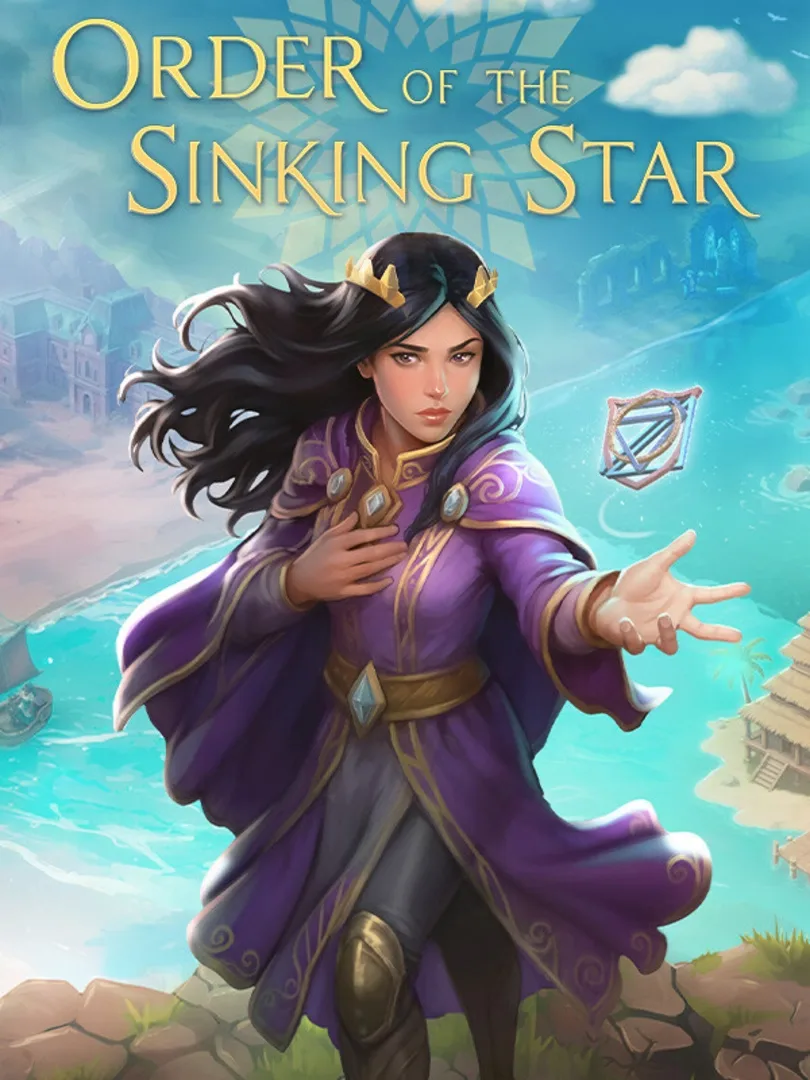

"Whereas many puzzle games dial the challenge back down when introducing new rules, Order of the Sinking Star feels like it's in constant escalation," wrote Polygon's impressions writer. That sentence is being read inside Thekla, Inc as a compliment. It is actually a warning.
The thesis: relentlessness is not the same as rigor
Order of the Sinking Star launched on October 8, 2026 on PC, PlayStation 5, and Nintendo Switch 2, priced at $29.99, developed by Thekla, Inc and published by Arc Games. It ships with over 1,000 interconnected, hand-crafted puzzles and a roster of unique playable heroes. On paper, that is generosity. In practice, early impressions describe something closer to an endurance test with a mystery bolted on. My argument: the design choice to never let the player exhale is going to cost this game its long tail, even while it is winning the opening week.
The evidence is sitting right there in the review coverage
Start with the number everyone will quote anyway: an "Overwhelmingly Positive" Steam rating, 97% positive out of 1,486 reviews as of October 12, 2026. That is a real signal, and it should not be dismissed. But look at what the two major outlet impressions actually praised and what they flagged.
- Kotaku's ten-hour preview called the puzzle design "very, very smart and fun and good," but separately described the build as feeling incomplete, with a mix of human and AI voice acting still unresolved.
- Kotaku also noted the narrative and overarching mystery were weaker than the puzzle craft around them — complicated, not clarifying.
- Polygon estimated the full experience at roughly 500 hours and warned that "much of that time will be spent staring at puzzles that seem impossible to solve for hours."
Put those three observations together and you get a consistent shape: the mechanical skeleton is excellent, the connective tissue — story, pacing, moments of release — is thin or unfinished. That is not a minor quibble. It is the difference between a game players finish and a game players bounce off at hour forty with a guilty conscience.
"I think the actual game here is very, very smart and fun and good, and I liked playing it," said Kotaku preview author Rebekah Valentine — immediately after describing a build that still felt unfinished.
The steelman: this is exactly what Jonathan Blow's audience signed up for
Here is the strongest version of the counter-argument, and it deserves real weight. Jonathan Blow built his reputation on Braid and The Witness — two games whose entire cultural footprint rests on refusing to hold the player's hand. Thekla, Inc's brand is deep, challenging puzzle design with artistic ambition attached. Nobody buying an Order of the Sinking Star Steam key at launch week was expecting a tutorial-paced power fantasy. A 97% positive rating from 1,486 reviews, written by people who chose this specific designer's specific reputation, is not a naive metric. It is a self-selected audience telling you the escalation is the point.
There is also a commercial logic to never softening the curve. A puzzle game that gates its hardest content behind optional rooms — as Blow's earlier titles did — lets casual players finish and quietly churn, while hardcore players chase secrets for years. If Order of the Sinking Star is genuinely a 500-hour structure built the same way, the escalation isn't a design failure. It's the retention mechanism. Difficulty, in this framing, is the live-service hook that a single-player puzzle game gets to use instead of battle passes.
Where the steelman breaks down
The problem is that Polygon's and Kotaku's criticisms aren't really about difficulty. They're about delivery. An unfinished mix of human and AI voice acting, a mystery that Kotaku calls complicated rather than compelling — those are production and narrative issues sitting on top of a puzzle engine that both outlets independently called smart. A hardcore audience will forgive brutal puzzles. It will not indefinitely forgive a story that can't keep pace with them, because the story is supposed to be the reward for solving the puzzle, not an afterthought layered on top of it.
| Dimension | Early verdict |
|---|---|
| Puzzle design | Praised as smart, fun, in constant escalation |
| Narrative/mystery | Called complicated, weaker than the mechanics |
| Production polish | Build felt incomplete; mixed human/AI voice work |
| Early commercial signal | 97% positive, 1,486 reviews |
The verdict
The launch numbers say Thekla, Inc has already won the argument. The review text underneath those numbers says the fight isn't over. A 1,000-puzzle, 500-hour structure priced at $29.99 is an extraordinary amount of content for the money, and the audience that shows up for Jonathan Blow games is precisely the audience willing to stare at an unsolvable room for an hour on principle. But escalation without mercy only works if everything surrounding the puzzles is finished and the mystery actually pays off the climb. Right now, by the dossier's own evidence, neither of those things is confirmed. The puzzles are the product. The rest of the game still has to catch up to them.
Sources :



Comments 0